
So, as promised. Here is my rendition of this wonderful story. Now, most of it falls straight from the book, however, there are some portions which seemed better in the movie and have therefore melded both into what you read below.
The Fourth Wise Man
“Behold, there came wise men from the east to Jerusalem,
saying, Where is he that is born King of the Jews? For we have seen his star in the east, and are come to worship him.”
~Matthew 2:1-2
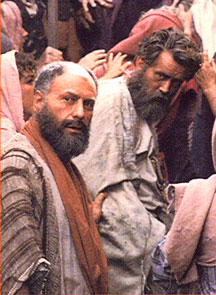
Alan Arkin and Martin Sheen in "The Fourth Wise Man"
This fictional story, written by Henry van Dyke more than a century ago, tells the tale of a Wise Man, Artaban, most likely an astronomer or astrologer, that decides to join the other Three Wise Men in their journey. In preparation, he sells all his possessions for three precious stones that he intends to give the baby King: A sapphire, “…as blue as a fragment of the night sky”; a ruby, “…redder than a ray of the sunrise”; and a pearl, “…as pure as the peak of a snow mountain at twilight.”
Much like our own journeys through life, what we plan and what God has planned for us are usually not in sync. His journey ends up much different and longer than what he anticipated.
The movie begins with Artaban, played by Martin Sheen, observing the stars and deciding to join the other three on their journey. He joins his father and friends asking who will journey with him to greet the newborn King. One by one, all the others come up with excuses NOT to join him and he finally is left by himself. Only his servant, played by Alan Arkin, follows him on his travels.
As they arrive at their first rest stop, a beggar approaches them pleading for help. Artaban’s servant asks him not to help him since it’s late and if they delay, they will miss their meeting point with the other Magi. However, Artaban, seeing that the ill beggar will die, decides to stay and treat him.
After several hours, the beggar, cared for and treated by Artaban is grateful for the Wise Man’s care.
“I have nothing to give thee in return,” says the grateful beggar. “Only this: that I can tell thee where the Messiah must be sought. For our prophets have said that he should be born not in Jerusalem, but in Bethlehem of Judah. May the Lord bring thee in safety to that place, because thou hast had pity upon the sick.”
Long past midnight, Artaban and his servant depart to meet the Magi. As they arrive at their meeting point, Artaban desperately searches for the other three only to discover they have left without him.
Disappointed, Artaban wonders how he will cross the desert without any rations to eat. He decides to head back to Babylon and sell the blue sapphire in order to buy several camels, food and water for the trip to Bethlehem.
After many days of travel, Artaban arrives in Bethlehem. He is told by a woman holding her child that the wise men had arrived, found Joseph, Mary and the young child, laid their gifts at his feet, and had disappeared as mysteriously as they had appeared. She goes on to say that not long afterwards, Joseph, Mary and their baby had secretly fled Bethlehem and it was rumoured they were travelling to Egypt.
As he listens to her story, her child reaches up to touch his face and smiles at him, warming his heart. Suddenly, there’s a commotion outside filled with shrieking and wailing of women’s voices. Amidst the confusion, Artaban hears a woman crying out, “The soldiers! the soldiers of Herod! They are killing our children.”
The woman, filled with terror, holds her now sleeping child, and hides in a dark corner of the house. The soldiers arrive at the house and their captain attempts to enter, but Artaban stops them.
“I am all alone in this place, and I am waiting to give this jewel to the prudent captain who will leave me in peace.” Artaban whispers softly as he drops his second precious stone, the red ruby, in the captain’s hand.
The captain, accepting the bribe, announces there are no children there, and the soldier’s proceed on to the next house.
Saddened by having to part with the second gift, wonders softly if he’s done the right thing by having, “…spent for man that which was meant for God.”
The woman, behind him assures him of his choice as she offers him her thanks and blessing.
“Because thou hast saved the life of my little one,” she whispers, “may the Lord bless thee and keep thee; the Lord make His face to shine upon thee and be gracious unto thee; the Lord lift up His countenance upon thee and give thee peace.”
For many years, Artaban and his servant travel in search of the King. He is told by a Hebrew rabbi in Alexandria that the King that Artaban seeks “is not to be found in a palace, nor among the rich and powerful,” but among the poor. He travels through many countries in his search of the family including many where famine had stricken, through plague-sticken cities. He visited the oppressed and afflicted. Through all these travels and lands, “though he found none to worship, he found many to help. He fed the hungry, and clothed the naked, and healed the sick, and comforted the captive.”
He spent his entire life in a journey he had not foreseen, never growing close to his King and feeling defeated, he grants his servant his freedom. The servant parts and arrives in Jerusalem during the season of Passover. Upon arriving, a great celebration is going on as people walk down the street carrying palm branches, and the curious servant asks the occassion for the commotion to which he is told that the prophet Jesus from Nazareth is in town. A man which was blind from birth and accompanying the servant, decides to follow the crowd while the servant goes back to his old master to tell him of the good news.
After 33 long years of searching for the King, and missing Him at every turn, he receives the news and is doubtful. He’s tired and reluctant to go on another failed journey. The servant insists, and Artaban is convinced when the blind man appears back at the village with his eyesight restored to see his mother for the first time.
Still doubtful that the King would receive him in his current state, the servant argues that Jesus has surrounded himself with the blind, crippled and poor. Artaban, his hope renewed, agrees and they start to Jerusalem.
Several days later, they arrive and he is told to go to Gethsemae to find Jesus. Upon arrival, they find a man weeping. They tell the man, that they are looking for Jesus to which the man replies he’s not heard of him. Artaban’s former servant argues, saying that the man is one of his disciples.
Again, the man says he does not know what they’re talking about. The servant again refutes the statement saying that he saw the man with Jesus the past Sunday.
The man, growing angry, shouts that he does not know the man. Upon which a rooster’s crow is heard in the distance. Broken, the man again begins to weep and tells Artaban that Judas betrayed Jesus to the pharisees and where to find him.
As they arrive at the gate, Artaban has an attack and falls. He awakens later to hear news that Jesus has been taken to a place outside the city walls called Calvary where they are to execute him.
He follows the crowd through the city, and gets near to Jesus carrying the cross. He attempts to hand him the gift before it is too late, but is too weak and falls behind.
Artaban grew nervous and troubled. After all this time, he, once again, has missed his opportunity to see his King and offer him his last remaining gift. But, he remembers, that God works in mysterious ways and it may be that it is he that is to find the King, in the hands of his enemies, and offer the pearl for his ransom.
As he follows the crowd, several soldier approach dragging a young girl. As Artaban watches her with compassion, he recognises her while she begs for his help. She confesses that her father was a merchant, who died and she was seized to be sold as a slave because of his debts.
Again conflict entered him. The same feeling he had felt at the beginning of his journey and at Bethlehem when he had lost the other two jewels. Now, here he stood, the last remaining opportunity to bring a gift to his King or save this poor girl before him.
Artaban stops the soldiers and, slowly, pulls the third and last precious stone, the pearl, from his pouch. “This is thy ransom, daughter!” He tells her sadly, as he places the pearl in her hand, “It is the last of my treasures which I kept for the King.”
As he watches her leave, he hears a loud voice yelling behind him. “My God, my God. Why hast though forsaken me?”
As he spoke, the sky grew dark, and a powerful earthquake shook the ground as Artaban grew sad. He knew what had just occurred and that his quest was over and failed.
Several days later, old, tired, and dying, he prepares to leave and they stop to rest. As he lays there, a figure approaches them, unseen by the servant.
Surprised to see Jesus alive, Artaban feels saddened.
“Lord, forgive me.” He begs. “Once, I had precious gifts to give, but now I have nothing…”
“Artaban,” the figure softly replies. “You have already given your gifts to me.”
“I don’t understand.” Artaban tells him confused.
Jesus quietly explains to him. “When I was hungry, you gave me to eat; when I was thirsty, you gave me to drink; when I was naked, you clothed me; when I was homeless you took me in…”
“Not so, my Saviour,” Artaban softly argues. “I never saw you hungry, nor thirsty. I never clothed you, and I never brought you into my home. I’ve never seen you until now.”
“When you did these things for the least of my brothers,” the sweet voice came again. “You did them for me.”
Overfilled with joy at what he has been told, he looks at his servant.
“We have found the King. And he has accepted all my gifts.” He tells him happily as he closes his eyes for the last time.
***
So, that concludes the story which captures the true meaning of Christmas…
…but it now brings up a good question in my mind. The star that the Wise Men followed, what actually was it? Well, I guess I have my next long article to start on…
 t0t4lk40s